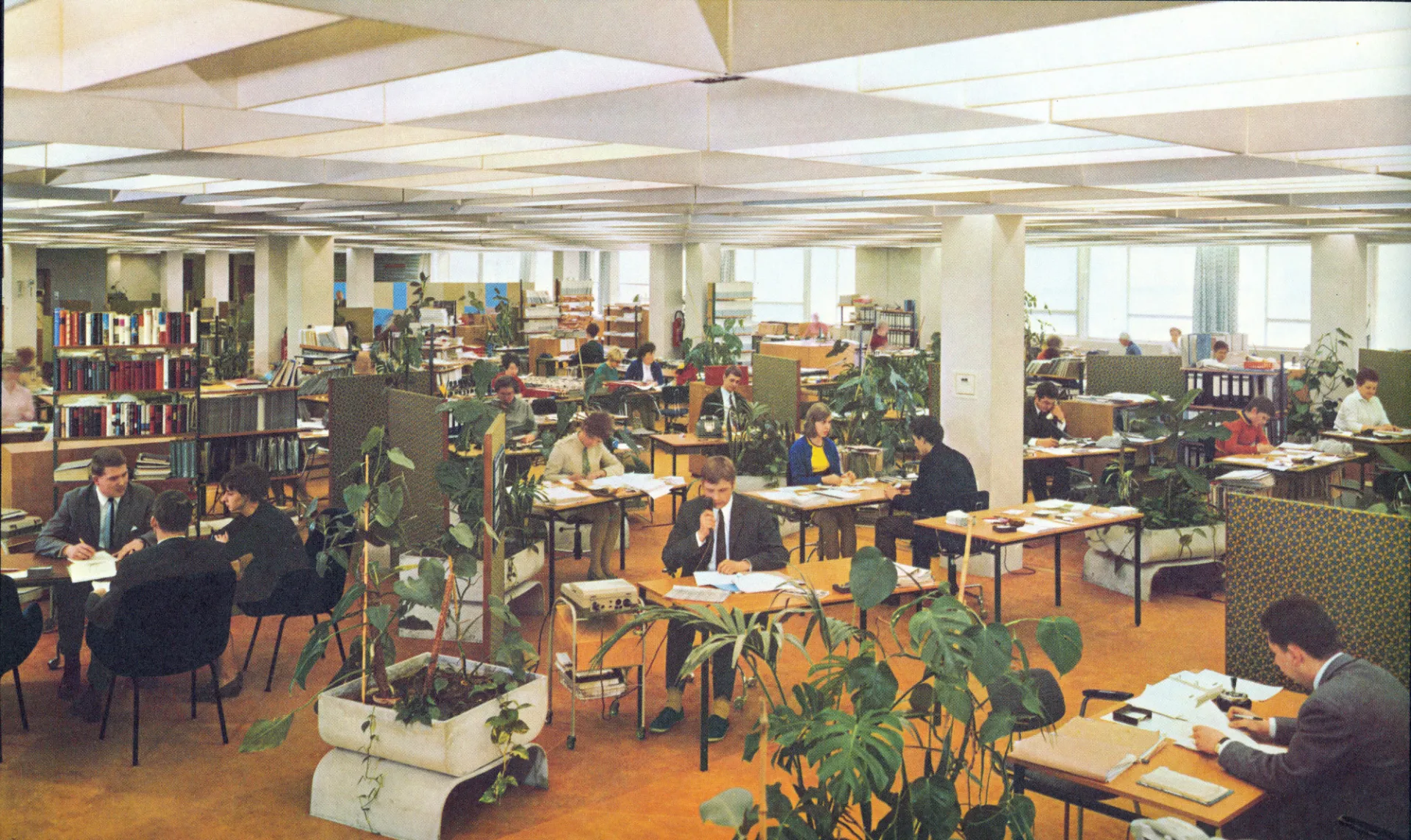
In 1961, 270 employees of the German publisher Bertelsmann moved into an office where desks stood at irregular angles among potted plants, arranged according to a chart of interdepartmental communication. The designers of this workplace, brothers Eberhard and Wolfgang Schnelle, called it a Bürolandschaft or office landscape. They presented it as an ideal setting for teamwork, a place for non-hierarchical collaboration suited to a West Germany trying to leave its authoritarian past behind. By 1972, some forty thousand people in nine countries worked in offices planned by the Schnelles’ firm, Quickborner Team. My talk will trace how an ideal of equals thinking together gave rise to a design process that measured communication, arranged desks, checked sightlines, and mitigated noise. These design experiments promised greater autonomy while making work relationships more available for managerial oversight. By reconstructing their ambitions and contradictions, I will consider what happens when community becomes an object of design and why the promise of teamwork keeps drawing us in.
Joseph Clarke is an associate professor and Chair of the University of Toronto Department of Art History, cross-appointed to the Daniels Faculty of Architecture, Landscape, and Design. His 2021 book Echo’s Chambers: Architecture and the Idea of Acoustic Space explores how architectural experimentation with sound was entangled with debates on style, visualization techniques, and the expansion of the listening public. He is currently writing a book on postwar office design. Clarke holds degrees from the University of Cincinnati and Yale. Before becoming a historian, he worked at Eisenman Architects and Skidmore, Owings & Merrill.
RSVP Instructions: Because entrance to campus currently requires a Columbia ID, please RSVP by Tuesday, Oct. 29 ONLY if you require guest access to this event. Due to campus restrictions we are unable to honor last-minute requests. Please do not RSVP if you have campus access.