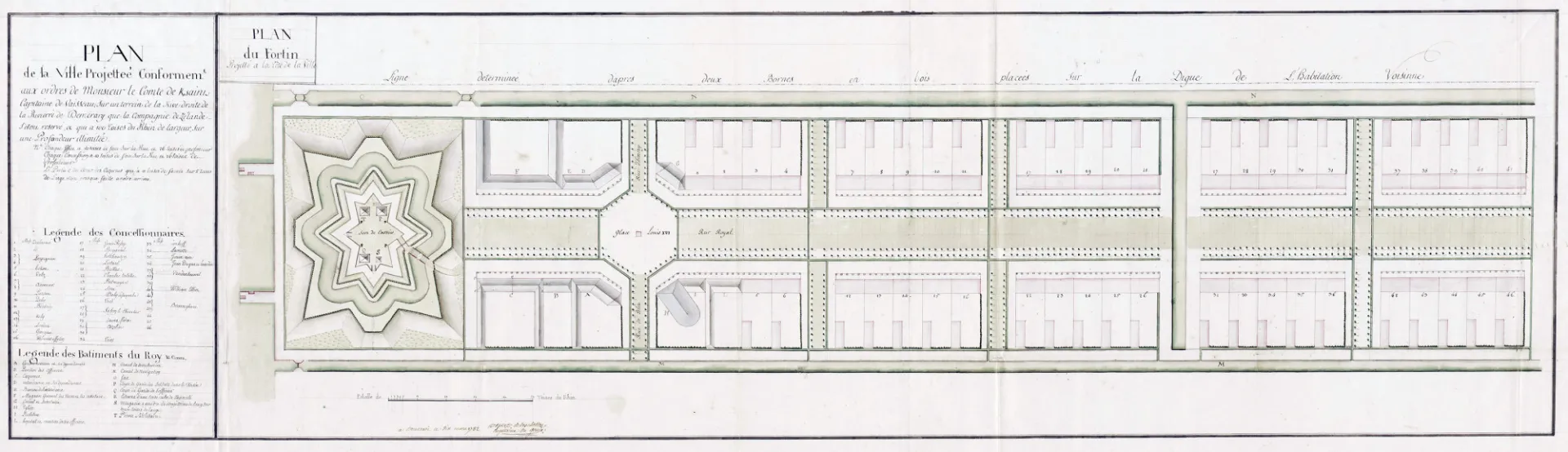
“Public Monuments and the Limits of Sovereignty” situates French Enlightenment architectural theory within the history of colonialism. The talk examines Armand-Guy Kersaint, whose Discours sur les monuments publics linked neoclassical architecture to the political ambitions of the French Revolution. It reads this essay alongside Kersaint’s infrastructure and urban planning projects as a colonial governor in Guiana, as well as his writings on suppressing the Haitian Revolution. Bringing his theories of public monumentality into conversation with his addresses on slavery and the colonies, this talk recasts Kersaint’s architectural thought as a project shaped by the contradictions of revolutionary sovereignty and colonial rule. Atlantic Unbound: Architecture in the World of the Haitian Revolution is forthcoming from University of Pittsburgh Press.
Peter Minosh is an historian of architecture, urbanism, and landscape. His work explores architecture’s modernity at the intersections of political sovereignty and revolutionary movements particularly around the eighteenth-century Atlantic world. He received his PhD in architectural History and Theory from Colombia's GSAPP and has taught at Oberlin College, Cornell University, University of Toronto, and Tufts University. He has published in the Journal of the Society of Architectural Historians, Race and Modern Architecture, and Architecture against Democracy. His book, Atlantic Unbound: Architecture in the World of the Haitian Revolution - from University of Pittsburgh Press - takes the French, American, and Haitian Revolution to be a single transnational phenomenon and considers how architecture negotiates its revolutionary imaginaries.
RSVP: Because entrance to campus currently requires a Columbia ID, please RSVP by Wednesday, November 11th at 9pm ONLY if you require guest access to this event. Due to campus restrictions we are unable to honor last-minute requests. Please do not RSVP if you have campus access.