NB: because entrance to campus currently requires a Columbia ID, please reach out to Zachary Torres ([email protected]) by Wednesday, October 8 if you require guest access this event. Due to campus restrictions we are unable to honor last-minute requests.
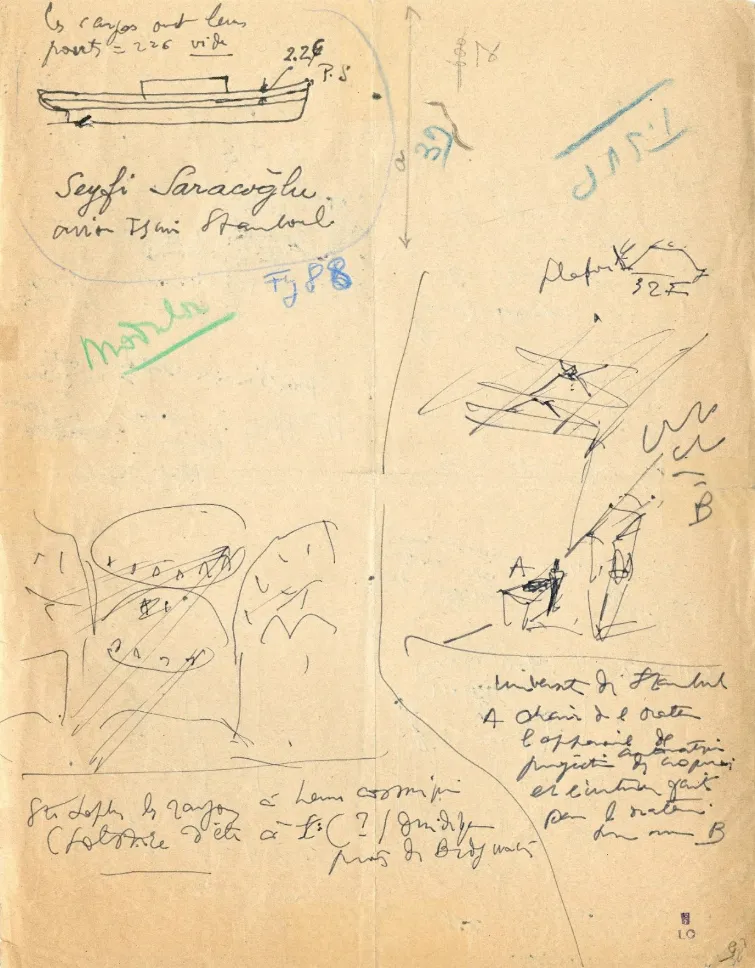
Le Corbusier systematically engaged with the past as a living resource, transforming earlier encounters and works into new architectural ideas. His travel experiences, in particular, provided an inexhaustible source of inspiration and rhetorical devices. Among the diverse travel materials he drew upon (including photographs, postcards, notes, and personal recollections), hand-drawn sketches proved exceptionally versatile, capturing the embodied experience of seeing, drawing, measuring, and moving through space. This talk focuses on travel recollections and hand-drawn sketches the architect included in The Modulor (1954), a book rich with autobiographical elements. Drawing on archival research and a close reading of Le Corbusier’s working methods, this talk demonstrates how these travel materials—sometimes created decades earlier—were repurposed, reinterpreted, and integrated into his anthropometric system of design and standardization. By tracing the unexpected afterlives of these sketches (as well as other historical references), the talk approaches the Modulor as an act of remolding the past: one that reconstructs Le Corbusier’s personal itinerary and forges a selective history of architecture into a new vision for mid-century design. Hand-drawn travel sketches thus emerge as living, malleable traces, mediating between experience, memory, and invention; they reveal the reflexive nature of architectural design, in which the past is never fixed but continuously mobilized and redrawn.
Panagiotis Farantatos is an architect and architectural historian, and associate professor of Art History at Aarhus University, Denmark, where he teaches courses on architecture, design, and the city. His research focuses on interwar and postwar modernism, standardization, architects’ travels, and the Mediterranean. He edited the Greek translations of Le Corbusier’s Modulor and Modulor 2 (2015). Recent publications include “Plastic Leisure for All. The Hexacube and the Seaside Development of Leucate-Barcarès” (Coastal Architectures and Politics of Tourism, Routledge, 2023) and “Embodied Memories, Retroactive Traces: Le Corbusier's Travel Sketches in Le Modulor” (Architectural Histories, 2024). He organized the symposium The Architecture of Copies / Copies of Architecture (Aarhus, 2022) and is General Chair of the 9th Biennial Conference of the European Architectural History Network (Aarhus, June 2026).